One controller for the whole energy system of a plant.
Battery storage, solar, generators, EV chargers and heat pumps under one controller on site. The cloud and the app show the site and let you change settings from anywhere.
Control lives on site. The cloud is never part of the control loop: if it is unavailable, the plant keeps working and you simply do not see it for a while.
Controller on site
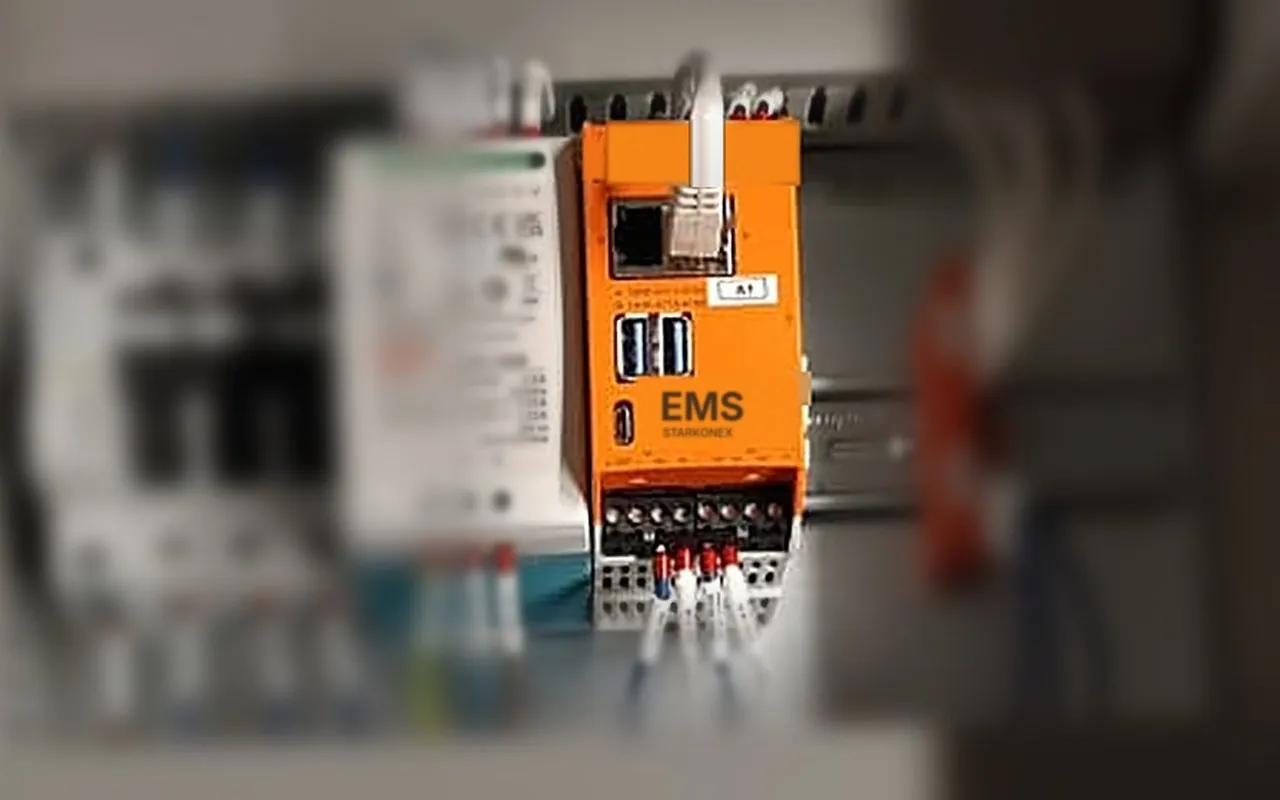
An industrial controller in the EMS cabinet polls every device on site, builds the day plan and runs the control functions.
Reads meters, inverters and battery cabinets every second
Keeps working without internet on the last settings
Every limit is enforced here, not in the cloud
Controls
Cloud
Stores the history of every site, calculates money and reports, sends alarms and delivers your setting changes to the controller.
Day-ahead prices and weather forecast for the plan
Alarms by push notification and email
Reports and exports for the owner and the operator
Shows and configures
App on any device
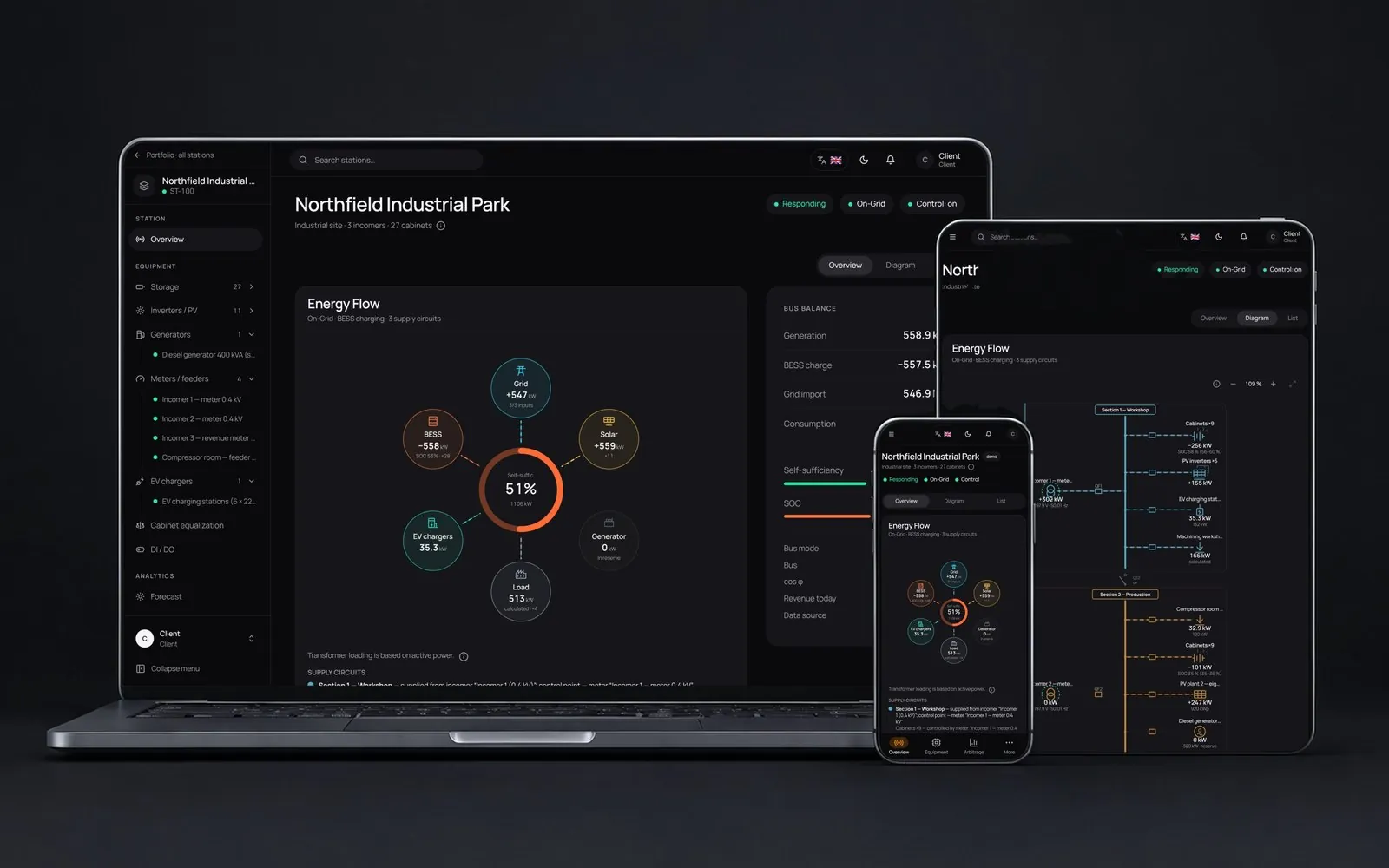
One app on phone, tablet and desktop, in seven languages. Every change shows whether the controller accepted it, not just that it was saved.
Energy flow, single-line diagram and every device
Roles for owner, operator, installer and service
Works locally on site, even without the cloud
For your team
Control strategies.
Choose how the battery earns or saves money. The controller on site carries it out.
Illustrative day
Day-ahead priceBattery
SolarPlant loadBattery
Your windowsBattery
The battery charges in the night and midday dips and discharges in the morning and evening peaks. The plan is rebuilt when new prices arrive.
Midday solar surplus charges the battery instead of being exported or curtailed. In the evening the battery covers the plant load.
Set the windows yourself. In each window the controller charges or discharges until the target state of charge is reached, then holds.
On top of any strategy: peak shaving, load shifting, blackout reserve and deep discharge protection. The curves show an illustrative day.
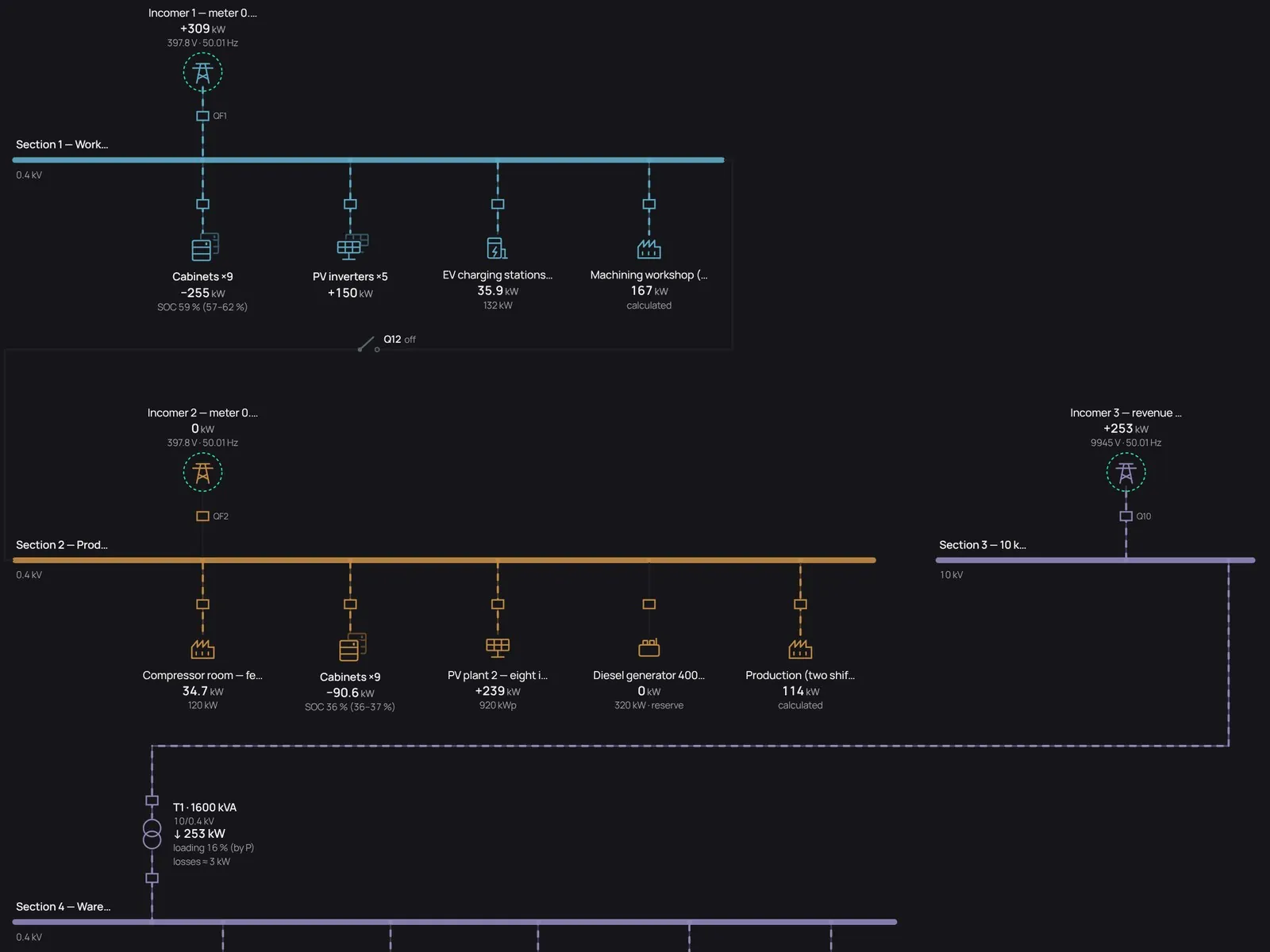
Built around your single-line diagram.
Draw the plant once in the app. Incomers, transformers and bus sections become the limits the controller follows.
Several incomers and bus ties. Each incomer has its own import and export limit and its own functions.
Zero export, total or per phase. For sites where the operator meters each phase separately.
Solar curtailment across many inverters. The EMS can be the only export limiter, or work behind an existing one.
All systems normalGrid lost: the site keeps running on battery and solarCloud unreachable: control continues on site
Works through failures.
Every failure has a defined, safe outcome. Pick one to see what happens.
Everything a plant runs on.
Battery storage
Many cabinets on one or several buses, balanced charge between cabinets.
Solar
Inverters from major brands, forecast from the weather, curtailment when needed.
Generators
Start, loading and stop together with the battery. Standard and Max.
Meters
Grid, feeder and solar meters over Modbus TCP and RS-485.
EV chargers
Charging from solar surplus, within the incomer limit. Standard and Max.
Heat pumps
Run on solar surplus or in cheap hours. Standard and Max.
Production equipment
If-then rules on the controller, 14 inputs and 14 outputs in Standard.
AI assistant
Onex explains what the station does and why, inside the app.
170+ supported device models. Not on the list? We add the driver without stopping the site.
Light, Standard or Max.
Every edition runs the same control on site. They differ in hardware, island and automation, and where the history and the app live. Tap an edition to highlight it, or answer three questions below.
EV chargers from solar surplus, within the incomer limit
—
Heat pumps on solar surplus or in cheap hours
—
Production equipment by schedule or condition
—
Emergency stop input
—
Energy control
Self-consumption, peak shaving, load shifting
Day-ahead price arbitrage
Cloud
Cloud
Manual schedule, backup reserve, deep discharge protection
Balancing charge between battery cabinets
Grid and solar limitsAll editions
Zero export, total or per phase
Import and export limit per incomer
Solar curtailment across many inverters
Several incomers, transformers and bus ties
Forecasts
Load forecast for the plant
Solar forecast from the weather
Cloud
Cloud
Next-day plan with day-ahead prices
Cloud
Cloud
Monitoring, app and service
Live energy flow, single-line diagram, history for every device
Reports to Excel, solar yield by day, month and year
Savings against a clear baseline
Cloud
Cloud
Alarms by push and email
Cloud
Cloud
AI assistant inside the app
Cloud
Cloud
Signed remote updates with rollback
Cloud
Cloud
Web app in seven languages, users, roles and change log
Setup wizard for installers, 170+ device models
Every edition controls the site locally and keeps working without internet. Price on request.Request a quote
Frequently asked questions.
What happens if the internet connection is lost?
Control keeps running on the controller on site with the last settings. The app shows that the site is not responding instead of presenting old values as current.
What equipment does Starkonex EMS work with?
Battery storage, solar and hybrid inverters, meters, EV chargers, heat pumps and generators over Modbus TCP or RS-485, more than 170 device models. Every project is checked against the equipment catalogue, and a missing driver is added without stopping the site.
Do I need to choose and configure a controller myself?
No. The controller comes in the EMS cabinet with a QR label. Scanning it adds the site to your account, and the setup wizard in the app does the rest.
Which electricity prices does the system use?
Hourly day-ahead prices for the bidding zone of the site. Grid fees, margin and VAT are set per site, so the plan uses the full price you actually pay.
Can one account manage the sites of several clients?
Yes. Companies form a hierarchy: a distributor sees the sites of its installers and their clients, and a client sees only its own sites.
How are updates delivered?
Controller firmware is updated remotely with signed packages, checks and automatic rollback. The cloud app is updated by us and needs nothing from you.
What is the difference between Light, Standard and Max?
All three run the same control on site. Standard adds a UPS, island mode, generators and the automation module for EV chargers, heat pumps and production equipment. Max adds a local server, so the history and the app stay at the plant.
Can I try the system before buying?
Yes. The live demo on the sign-in page of the app runs on simulated data and needs no registration. A demo on your own equipment is available on request.
The EMS cabinet.
Delivered assembled and tested, ready to install.
Industrial controller
DIN-rail industrial controller with its own power supply. Standard adds a UPS and the automation module.
CE marked
LVD 2014/35/EU, EMC 2014/30/EU, RoHS 2011/65/EU. Built to EN IEC 61439-1/-2. No radio modules.
Secure by design
Signed updates with rollback, local access on site without internet, roles and a change log.
StarkTech Engineering s.r.o. uses necessary cookies to run this site. With your consent we also use Google Analytics from Google Ireland Ltd. to count visits and improve the site. You can accept, reject or choose by category, and change your choice at any time with the cookie button.
We use cookies and similar storage in your browser. Necessary ones keep the site working and cannot be switched off. Everything else is used only if you allow it. Details are in the cookie policy.
NecessaryAlways active
Needed for the site to work: your language and your cookie choice. They do not identify you and are not shared.
Cookie
Purpose
Stored as
Expires
sx_consent
Remembers your cookie choice
Cookie
6 months
sx_consent_v2
Remembers your cookie choice and its date
Local storage
6 months
sx_lang
Language detected from your browser, for this visit only
Session storage
When you close the browser
sx_lang
The language you picked in the language menu
Local storage
12 months
Analytics
Google Analytics 4 counts visits and shows which pages are used, so we can improve the site. Provider: Google Ireland Ltd. Data may be transferred to the USA under the EU–US Data Privacy Framework.
Cookie
Purpose
Stored as
Expires
_ga
Google Analytics: distinguishes visitors
Cookie
2 years
_ga_*
Google Analytics: keeps the session state
Cookie
2 years
AdvertisingNot used
We do not use advertising or retargeting cookies on this site.